Personal Injury Law Blog

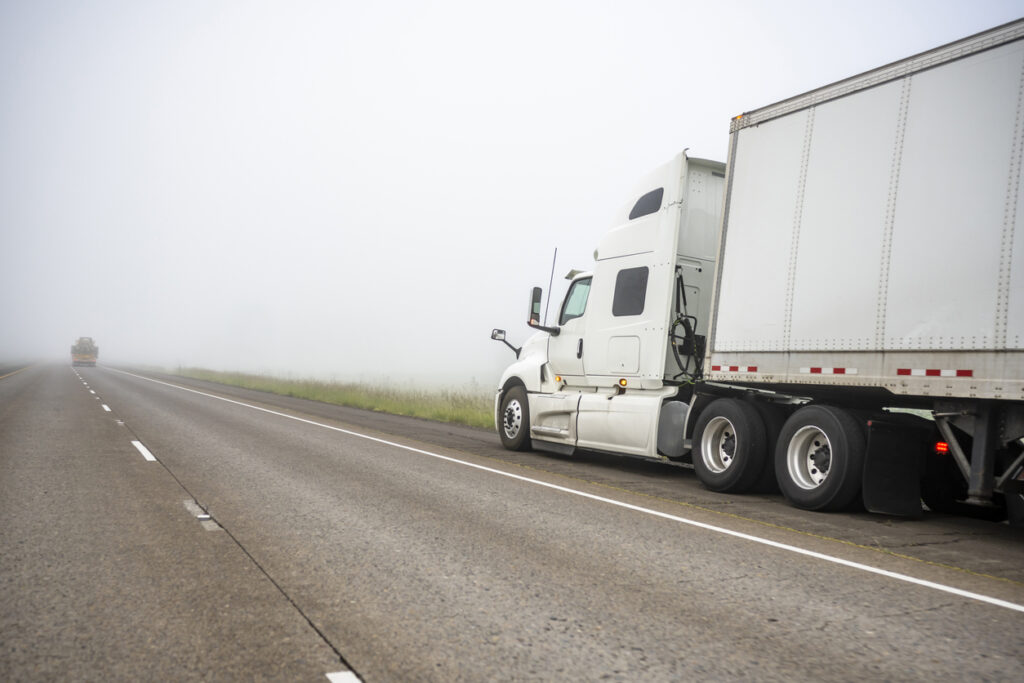 Anyone who regularly drives the PA Turnpike or any other major highway in the Commonwealth has probably become accustomed to seeing tractor-trailers parked on the shoulder of the roadway. While this practice may seem commonplace, the reality is that truck drivers who park in this “sitting duck” position are creating a significant safety hazard for motorists and likely violating Pennsylvania law.
According to recent data published by the Federal Motor Carrier Safety Administration (“FMCSA”), there were over 200 fatal crashes involving parked or working large trucks between 2018 and 2020 which constitutes roughly 4-5% of all fatal large truck crashes across the country.[1] An FMCSA study of fatal parked-truck crashes determined that 68% of these crashes occurred on the shoulder of the road and 55% occurred between 1:00 am and 8:00 am when approaching drivers are most fatigued.[2]
Initially, it might seem like the approaching driver is at fault for these crashes due to their failure to identify the presence of a large, parked truck on the shoulder of the roadway. However, drivers who strike conspicuous stopped vehicles routinely report never seeing them, despite markings and flashing lights. This is generally attributed to a number of factors including driver fatigue, target fixation, and difficulties in perceiving that the truck is stopped from a distance while travelling at a high rate of speed.
There is currently no federal regulation explicitly prohibiting “sitting duck” parking on highways. However, 49 CFR § 392.22 does provide some requirements for drivers that are forced to do this in emergency situations including use of hazard flashers, reflective triangles, and/or flares to alert approaching traffic to their location. Pennsylvania law does explicitly prohibit non-disabled trucks from standing or parking “on a limited access highway unless authorized by official traffic-control devices” 75 Pa.C.S. § 3353(a)(2)(vii).
In summary, truck drivers in Pennsylvania are not permitted to park in a “sitting duck” position unless their vehicle is truly disabled, it is necessary to avoid a crash, or they are directed to do so by a traffic-control device and/or law enforcement. Even if one of these conditions are met, the driver must comply with emergency response rules set forth by federal and state law. It is never permissible for a truck driver to park in “sitting duck” position when they are sleeping, running out of hours of service, making phone calls, completing paperwork, or checking a load. Each of these scenarios can be avoided and represents a planning failure on the part of the driver and motor carrier.
Given the well-known danger created by “sitting duck” parking, a reasonably safe motor carrier should have a formal written policy in place prohibiting drivers from engaging in this behavior. Drivers should also be trained on trip planning, including making plans for safe parking locations along their route before the trip begins. Motor carriers that utilize video event data recorders with location data have the capability to immediately determine when a driver is parked in a “sitting duck” location. Motor carriers that employ this technology should use it to monitor drivers and flag every stop on a highway shoulder or ramp. In the absence of a true emergency, these drivers should be disciplined and provided with remedial training to correct this behavior.
[1] FMCSA Large Truck Fatal Crash Table 26 (fmcsa.dot.gov).
[2] FMCSA “Truck Parking Crashes,” ART Forum 2023 (fmcsa.dot.gov/sites/fmcsa.dot.gov/files/2023-04/Art Forum 2023 Truck Parking Crashes 508.pdf.

Bruce H. Stern, Esq. Secures $5.5 Million Settlement for Traumatic Brain Injury Victim
Stark & Stark is pleased to announce that Shareholder Bruce H. Stern, Esq., Certified Civil Trial Attorney and member of the firm’s Accident...“Best Law Firms” 2027 List Issued by Best Lawyers Recognizes Stark & Stark PC
We are proud to announce that the firm has been included in the 2027 Edition of Best Lawyers “Best Law Firms®” list, earning 11 regional...Bruce H. Stern, Esq. Secures $950,000 Settlement for Traumatic Brain Injury Client
Stark & Stark is pleased to announce that Shareholder Bruce H. Stern, Esq., Certified Civil Trial Attorney and member of the firm's Accident...Evan J. Lide, Esq. Secures $2.15 Million Wrongful Death Settlement
Stark & Stark is pleased to announce that Shareholder Evan J. Lide, Esq. recently secured a $2,150,000 settlement on behalf of the family of a...Stark & Stark Attorneys Recognized as New Jersey “Super Lawyers” and “Rising Stars” in 2027
Stark & Stark is pleased to announce that 16 of its attorneys have been selected for inclusion in the list of 2027 New Jersey Super Lawyers,...Stark & Stark’s Chinsu Shajan, Esq. Receives Mercer County Bar Association Rising Leader Award
Stark & Stark is proud to announce that Chinsu Shajan, Esq., a Shareholder in the Firm’s Accident & Personal Injury Group, was honored by...