Business & Commercial Law Blog

As a Pennsylvania landlord, your priority is to protect your property, control risk, and recover rent with as little disruption as possible. Two areas that frequently create confusion are “self‑help” evictions and distraint (distress for rent), along with the lawful tools you actually can use when a tenant breaches the lease. Understanding where the lines are drawn can mean the difference between a clean resolution and a lawsuit.
“Self-help” refers to a landlord taking direct action to remove a tenant or reclaim possession of a rental property without going through the court system. Examples include changing the locks, shutting off utilities, removing tenant belongings, or otherwise forcing a tenant out.
In Pennsylvania, self-help eviction is illegal in nearly all residential situations.
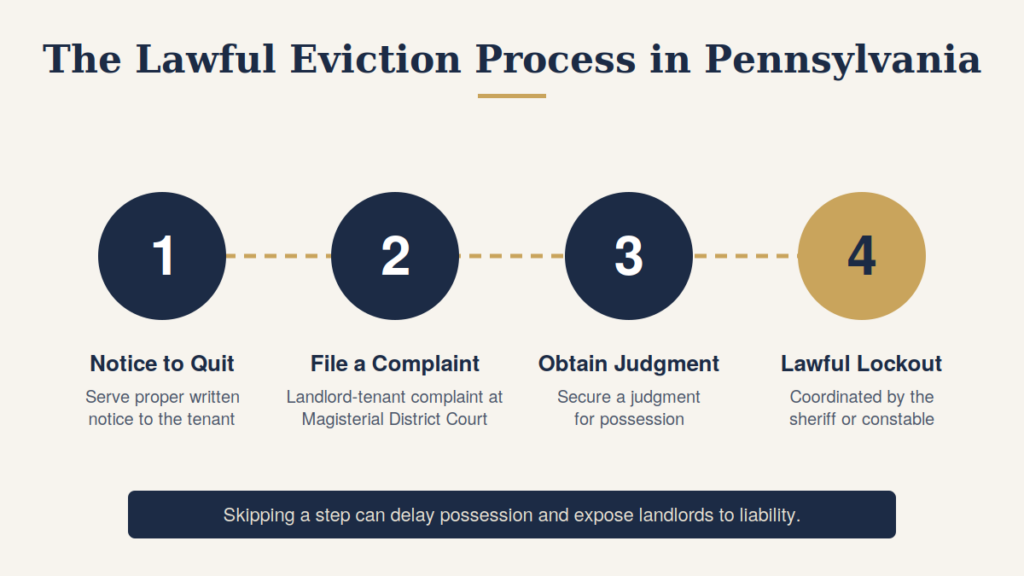
Landlords must follow the formal eviction process, which includes:
Attempting to bypass this process exposes landlords to significant liability. Courts in Pennsylvania have consistently held that tenants who are unlawfully evicted may recover damages, including compensation for lost property, temporary housing costs, and, in some cases, punitive damages.
There are very narrow circumstances where self-help may be permitted, primarily in commercial leases and only when the lease explicitly authorizes it. Even then, the landlord must act peacefully and without breaching the peace.
Distraint, or distress for rent, is an ancient common law remedy that allowed landlords to seize a tenant’s personal property to satisfy unpaid rent. While this remedy once played a significant role in landlord-tenant law, its modern use in Pennsylvania is largely abolished.
In commercial settings, although distraint may still be referenced in some lease agreements, many landlords instead rely on contractual remedies or court enforcement mechanisms. Distraint is codified at 68 Pa. Stat. Ann. § 250.30 et seq. While there is statutory authority for distraint, which includes criteria for notice, the contents of the notice, service of the notice, and limitations on what can be distrained, the constitutionality of the distraint procedures are in conflict. Therefore, landlords that rely on the statute and/or lease language could be held liable for trespass or conversion.
Courts have upheld the distraint procedures, holding that the Landlord Tenant Act sets out clear procedures and did not violate due process since statute’s specific notice requirements safeguarded the guarantees therein. However, given that “self-help” remedies have continuously shown to be disfavored in Pennsylvania, landlords should be cautious to use distraint remedies despite caselaw and statutory authorities that continue to be valid law.
Given the limitations on self-help and distraint, landlords in Pennsylvania typically must rely on lawful remedies provided by statute and contract.
The primary remedies include:
Each of these remedies require adherence to procedural rules. Skipping steps or acting prematurely can jeopardize a landlord’s case or open a landlord up to liability.
Engaging in self-help can lead to lawsuits, financial penalties, and reputational harm. Improper handling of tenant property may result in conversion claims. Failure to follow eviction procedures can delay recovery of possession and rent. While these rules may seem straightforward, the law is filled with nuance. Landlords face real risks when the nuance of these rules are not followed.
The safest course for both sides is to follow the legal process carefully and seek guidance when uncertainty arises.
Pennsylvania landlord-tenant law is highly procedural. Although a landlord may have text messages that illustrate that all parties are fully aware of the relief being sought, that does not necessarily allow certain procedural steps to be skipped. Small missteps, skipping seemingly redundant notices, or timing issues can quickly can derail an otherwise valid claim.
If you own or manage residential or commercial property in Pennsylvania, it is important to have a clear strategy for responding to late payments, lease violations, and problem tenancies before they escalate. The right approach can minimize holdover tenants, improve your ability to collect, and reduce your exposure to tenant claims.
Stark & Stark’s landlord‑tenant attorneys regularly advise landlords on:
Proactive legal advice can help you avoid common pitfalls and protect the long‑term value of your investment. At Stark & Stark, our attorneys regularly advise landlords on best practices and represent clients in disputes involving all aspects of relief. Proactive legal guidance can help you avoid common pitfalls and protect your investment.

Bruce H. Stern, Esq. Secures $5.5 Million Settlement for Traumatic Brain Injury Victim
Stark & Stark is pleased to announce that Shareholder Bruce H. Stern, Esq., Certified Civil Trial Attorney and member of the firm’s Accident...“Best Law Firms” 2027 List Issued by Best Lawyers Recognizes Stark & Stark PC
We are proud to announce that the firm has been included in the 2027 Edition of Best Lawyers “Best Law Firms®” list, earning 11 regional...Bruce H. Stern, Esq. Secures $950,000 Settlement for Traumatic Brain Injury Client
Stark & Stark is pleased to announce that Shareholder Bruce H. Stern, Esq., Certified Civil Trial Attorney and member of the firm's Accident...Evan J. Lide, Esq. Secures $2.15 Million Wrongful Death Settlement
Stark & Stark is pleased to announce that Shareholder Evan J. Lide, Esq. recently secured a $2,150,000 settlement on behalf of the family of a...Stark & Stark Attorneys Recognized as New Jersey “Super Lawyers” and “Rising Stars” in 2027
Stark & Stark is pleased to announce that 16 of its attorneys have been selected for inclusion in the list of 2027 New Jersey Super Lawyers,...Stark & Stark’s Chinsu Shajan, Esq. Receives Mercer County Bar Association Rising Leader Award
Stark & Stark is proud to announce that Chinsu Shajan, Esq., a Shareholder in the Firm’s Accident & Personal Injury Group, was honored by...