Business & Commercial Law Blog

 Sometimes reality follows fiction.
In Michael Connelly’s The Proving Ground, attorney Mickey Haller represents a mother whose daughter was murdered by an ex-boyfriend who has encouraged to kill by an artificial-intelligence chatbot. The mother wants more than compensation. She wants accountability and guardrails to prevent another tragedy.
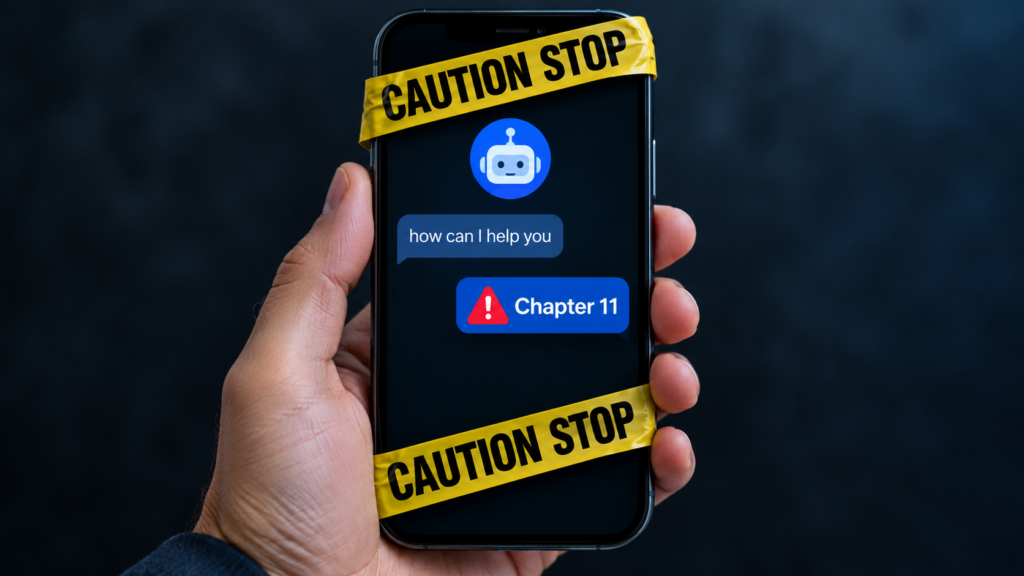
On October 12, 2026, that fictional concern met a real-world counterpart: Character Technologies Inc., the company behind Character.AI, filed for Chapter 11 protection in Delaware. The filing raises a related question: can a company transfer valuable AI technology through bankruptcy while leaving behind obligations intended to prevent future harm?
The answer requires separating three issues: government enforcement from collection, continuing compliance obligations from monetary claims, and inherited liability from responsibility for a purchaser’s own conduct.
According to Character.AI’s investment banker, during a pre-bankruptcy marketing process 28 prospective parties were approached. The responses were consistent. While the product and user base were attractive, the litigation and regulatory overhang presented significant impediments to a deal.
That overhang includes pending proceedings in Kentucky and Pennsylvania. Kentucky alleges that Character.AI prioritized engagement over children’s safety and violated consumer-protection and other laws. It seeks monetary and injunctive relief. Pennsylvania seeks to prevent chatbots from allegedly posing as licensed medical professionals, including a purported psychiatrist that supplied a false license number.
Character.AI now proposes a $20 million transaction with Disney Worldwide Services Inc., centered on a perpetual, nonexclusive technology license. Disney would not acquire the existing consumer-facing applications, finished conversational models, training data, or end-user data. It would receive tools for developing its own products rather than take over the challenged service.
That structure frames certain immediate questions: can the states continue pursuing safety restrictions, and how far can the sale order protect Disney?
The automatic stay generally halts prepetition proceedings against the debtor, enforcement of prepetition judgments, and collection efforts against estate property. 11 U.S.C. § 362(a). But § 362(b)(4) of the Bankruptcy Code preserves qualifying governmental police-and-regulatory proceedings, including enforcement of judgments other than money judgments.
The distinction is between regulation and collection. A state may be able to establish liability or obtain an injunction stopping unlawful conduct while remaining unable to collect a monetary judgment from estate property. In re Mystic Tank Lines Corp., 544 F.3d 524 (3d Cir. 2008).
Compliance costs do not alone change that result. In Penn Terra, Ltd. v. Department of Environmental Resources, 733 F.2d 267 (3d Cir. 1984), the court permitted enforcement of an environmental injunction despite the resulting expense to the debtor. The question was whether the state was enforcing its regulatory authority as an equitable action to prevent future harm, not whether compliance would reduce estate assets.
In one of Character.AI’s first day motions, it has proposed a worldwide-stay order that recognizes this framework. Although Character.AI seeks broad protection against disruption of its business, the order expressly preserves statutory exceptions and qualifying governmental enforcement. The order does not set forth whether the Kentucky or Pennsylvania actions, or every remedy requested in them, are stayed.
Connelly’s mother supplies the human counterpart: compensation for past injury and prevention of future harm are different objectives. Bankruptcy addresses the first through a claims process without necessarily displacing the second.
A related question arises when regulators demand affirmative corrective action rather than simply seeking to prohibit conduct. Does the obligation remain enforceable, or can it be treated as a bankruptcy claim?
In In re Torwico Electronics, Inc., 8 F.3d 146 (3d Cir. 1993), the court held that an obligation to remedy an ongoing environmental hazard was not a bankruptcy claim because the state demanded compliance, not payment, thus exercising the state’s inherent regulatory and police powers
Ohio v. Kovacs, 469 U.S. 274 (1985), illustrates the other side. The debtor had been dispossessed of the site, and the cleanup obligation had effectively become a demand for money. The Court treated it as a dischargeable claim without granting immunity for future pollution.
Applied to Character.AI, the substance of the requested relief matters more than its label. An obligation to stop or correct an ongoing harmful practice differs from a demand for payment addressing past conduct. The states’ injunction requests therefore cannot be assumed either to disappear in bankruptcy or automatically ride through unhindered.
The proposed sale presents a separate question. Disney seeks an order declaring that it is not a continuation of Character.AI and barring covered claims against it, including claims asserted by governmental and regulatory authorities. Disney requires an acceptable free-and-clear order as a condition of closing.
Section 363(f) can provide substantial protection against historical successor liabilities. In In re Trans World Airlines, Inc., 322 F.3d 283 (3d Cir. 2003), the court upheld a broad reading of a sale free and clear of specified successor-liability claims connected to the transferred assets, which included employment discrimination claims.
But protection from inherited liability is not immunity for a purchaser’s own wrongdoing. In re Motors Liquidation Co., 829 F.3d 135 (2d Cir. 2016), distinguished successor claims from claims based on independent post-closing conduct.
That distinction matters here. Holding Disney liable merely because it licensed Character.AI’s technology presents one issue. Regulating a new product Disney develops or deploys presents another.
Whether an injunction against Character.AI binds Disney is also a separate inquiry. Injunctions do not automatically follow software; their reach depends on governing law, their terms, and the purchaser’s conduct and relationship to the restrained parties. Kentucky’s request to reach successors and assigns makes the question significant but does not establish the answer.
The issue is not whether every safety obligation disappears or automatically transfers. It is whether the final order distinguishes historical claims, continuing regulatory duties, injunctions binding particular parties, and obligations arising from Disney’s own conduct.
Regulators will likely seek language preserving enforcement against independently unlawful post-closing conduct. Disney has a corresponding interest in avoiding responsibility for Character.AI’s historical practices. Those positions are not irreconcilable.
In The Proving Ground, the mother insists that resolution of her tragedy should help prevent another. Character.AI’s bankruptcy presents the transactional version of that concern: technology may change hands, but the sale order should make who is responsible for future harm clear.
Stark & Stark’s Bankruptcy & Creditors’ Rights Group helps creditors, commercial landlords, and other affected parties navigate business distress, including lease assumption and rejection, guaranty exposure, and recovery strategies. Understanding those rights early can make a meaningful difference when a growing business or an emerging industry begins to retrench.
For more information on how Stark & Stark can assist you, please contact shareholders Joseph Lemkin at (609) 791-7022 (jlemkin@stark-stark.com) or Thomas Onder at (609) 219-7458 (tonder@stark-stark.com).

Bruce H. Stern, Esq. Secures $5.5 Million Settlement for Traumatic Brain Injury Victim
Stark & Stark is pleased to announce that Shareholder Bruce H. Stern, Esq., Certified Civil Trial Attorney and member of the firm’s Accident...“Best Law Firms” 2027 List Issued by Best Lawyers Recognizes Stark & Stark PC
We are proud to announce that the firm has been included in the 2027 Edition of Best Lawyers “Best Law Firms®” list, earning 11 regional...Bruce H. Stern, Esq. Secures $950,000 Settlement for Traumatic Brain Injury Client
Stark & Stark is pleased to announce that Shareholder Bruce H. Stern, Esq., Certified Civil Trial Attorney and member of the firm's Accident...Evan J. Lide, Esq. Secures $2.15 Million Wrongful Death Settlement
Stark & Stark is pleased to announce that Shareholder Evan J. Lide, Esq. recently secured a $2,150,000 settlement on behalf of the family of a...Stark & Stark Attorneys Recognized as New Jersey “Super Lawyers” and “Rising Stars” in 2027
Stark & Stark is pleased to announce that 16 of its attorneys have been selected for inclusion in the list of 2027 New Jersey Super Lawyers,...Stark & Stark’s Chinsu Shajan, Esq. Receives Mercer County Bar Association Rising Leader Award
Stark & Stark is proud to announce that Chinsu Shajan, Esq., a Shareholder in the Firm’s Accident & Personal Injury Group, was honored by...