Personal Injury Law Blog

What We Know and What Happens Next for Workers and Families
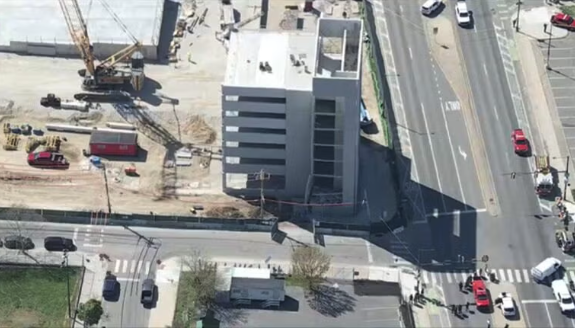
A partially constructed parking garage collapsed in the Grays Ferry neighborhood of Philadelphia on April 8, 2026, killing one construction worker, injuring two others, and leaving two more unaccounted for beneath the rubble. The seven-level structure was being built on the 3000 block of Grays Ferry Avenue to expand employee parking for the Children’s Hospital of Philadelphia (CHOP).
As search and rescue operations continue, questions about construction safety, accountability, and what comes next for affected workers and their families are growing louder by the hour.
The collapse was reported just after 2 p.m. on Wednesday, April 8, at the construction site on the 3000 block of Grays Ferry Avenue, directly across from the Grays Ferry Shopping Center. Philadelphia Fire Commissioner Jeffrey Thompson confirmed that crews arriving on scene rescued three workers. One was transported to a nearby hospital, where he was later pronounced dead. Two others were treated and released.
As of Wednesday evening, two additional workers remained unaccounted for and were believed to be trapped in the lower levels of the structure near a stairwell. Commissioner Thompson stressed that the building is compromised and must be stabilized before rescue crews can safely continue their search.
Residents in the area described the terrifying moments of the collapse. One witness recalled watching the floors fall one by one. Others living blocks away initially thought an earthquake had hit, with homes shaking and a massive cloud of dust rising from the site.
The workers involved are members of Ironworkers Local 401, the Philadelphia-based union whose members were on site at the time of the collapse.
Philadelphia Mayor Cherelle Parker addressed the public on Wednesday evening with preliminary details about what went wrong. According to Mayor Parker, a subcontractor called Precast Services Inc. was installing precast concrete floor decking and roof segments on the structure. After placement, a precast roof segment failed and fell to the level below. That initial failure triggered a progressive collapse of connected sections across all seven levels of the garage.
The mayor confirmed that the precast concrete components were manufactured off-site and installed by the manufacturer. She noted that this process does not require standard inspections from the city’s Department of Licenses and Inspections (L&I). Instead, it falls under required special inspections for precast concrete installations. The city reported that eight permits were required for the project, all of which were properly issued and had up-to-date inspections.
A “progressive collapse” means that the failure of one structural element placed enough stress on the surrounding connections to cause a chain reaction throughout the entire building. Investigating what caused the initial roof segment to fail, and why the rest of the structure could not absorb that failure, will be central to the months-long investigation ahead.
The Occupational Safety and Health Administration (OSHA) is the federal agency responsible for setting and enforcing workplace safety standards across the country. Under federal reporting requirements (29 CFR 1904.39), employers must report any work-related fatality to OSHA within eight hours. OSHA personnel were already on scene Wednesday evening.
Here is what the OSHA investigation process typically looks like in a case like this:
It is important to understand that this process takes time. OSHA investigations into incidents of this scale often take six months or longer due to the complexity of the review and the agency’s caseload. The findings, including any citations or violations, will eventually be made public.
While OSHA’s investigation focuses on workplace safety compliance, its findings often play a significant role in related legal proceedings. If OSHA identifies safety violations, those findings can serve as important evidence in claims brought by or on behalf of injured workers and anyone considering a Philadelphia parking garage collapse lawsuit.
The collapse has had immediate ripple effects across the Grays Ferry neighborhood, a tight-knit community in South Philadelphia. Grays Ferry Avenue from 29th to 33rd streets is closed to traffic, and the shopping plaza across the street, which includes a grocery store and other businesses, has also been shut down until further notice.
Residents and business owners in the surrounding blocks have been told to expect disruptions for the foreseeable future, with no reopening timeline available.
The parking garage project itself had been a source of community debate well before the collapse. Earlier this year, neighborhood residents organized protests over the construction, raising concerns about increased traffic congestion, environmental health, and air quality in the area. The planned 300,000-square-foot structure was intended to serve CHOP employees, and the hospital had stated it held more than 20 community meetings in an effort to address residents’ concerns.
Now, the neighborhood faces a different and far more pressing set of challenges as it waits for answers about what went wrong.
Determining liability after a construction collapse of this scale is a complex process, and it is one of the first questions a Grays Ferry construction accident lawyer would investigate. Large construction projects involve many different parties, and more than one may share responsibility for what went wrong.
Construction work is one of the most dangerous occupations in the country. According to the Bureau of Labor Statistics, the construction industry consistently accounts for a disproportionate share of workplace fatalities and serious injuries each year.
In the Grays Ferry collapse, where a subcontractor was installing precast concrete manufactured off-site, questions about material quality, installation practices, engineering oversight, and site safety all become relevant. Potentially liable parties in a case like this could include:
Determining who bears responsibility is a process that takes careful investigation, and it is a critical step for workers or families considering legal action.
When a construction worker is injured on the job in Pennsylvania, there are generally two potential paths to seek compensation.
Pennsylvania law requires nearly all employers to carry workers’ compensation insurance. This is a no-fault system, meaning injured workers can receive benefits regardless of who caused the accident. Workers’ compensation typically covers medical expenses and a portion of lost wages. In fatal cases, surviving family members may be eligible for death benefits, including coverage of funeral expenses and ongoing financial support.
While workers’ compensation generally prevents employees from suing their own employer, there are situations where a party other than the employer may share responsibility. If a third party’s negligence or a defective product contributed to an injury, the worker or their family may be able to pursue a separate personal injury lawsuit. Unlike workers’ compensation, these claims can include compensation for pain and suffering, full lost wages, and other damages.
Workers and families affected by a construction collapse can pursue both paths at the same time. A construction accident attorney can help identify which parties may be liable and which claims make sense for your situation.
Here are answers to some common questions about the Grays Ferry garage collapse, construction worker safety, and the legal process that follows an incident like this.
In Pennsylvania, if a third party’s negligence contributed to a worker’s death on a construction site, the worker’s family may have the right to file a wrongful death lawsuit in addition to receiving workers’ compensation death benefits. These claims can seek damages that workers’ compensation does not cover, such as loss of companionship and pain and suffering.
Workers’ compensation is a no-fault system that provides medical benefits and partial wage replacement to injured workers, regardless of who caused the accident. A third-party claim is a separate personal injury lawsuit against someone other than the worker’s employer, such as a subcontractor, equipment manufacturer, or property owner, whose negligence contributed to the injury. Third-party claims require proof of negligence but can provide broader compensation.
An OSHA citation means the agency found that an employer or responsible party violated one or more federal workplace safety standards. Citations can range from non-serious to willful violations, and they carry financial penalties. While OSHA penalties do not go directly to injured workers, the findings can be used as evidence in related legal claims to help establish that safety standards were not met.
Yes. Federal law protects workers who report safety hazards or file complaints with OSHA. Workers cannot be fired, demoted, or otherwise retaliated against for exercising their right to a safe workplace. If you believe you have faced retaliation for reporting a safety concern, you have the right to file a whistleblower complaint with OSHA.
No. In fact, it is better not to wait. An attorney can begin an independent investigation immediately, preserving critical evidence before it is lost during demolition or cleanup. OSHA’s findings may take six months or longer, and under Pennsylvania law (42 Pa. C.S. § 5524), the statute of limitations for personal injury and wrongful death claims is two years. Early action gives your legal team the best foundation to build a strong case.
The Grays Ferry garage collapse is a devastating reminder of the serious risks and injuries construction workers face every day. If you or a loved one has been injured in a construction site accident in Pennsylvania or New Jersey, the attorneys at Stark & Stark are ready to listen, answer your questions, and help you understand your legal options.
With more than 90 years of experience serving our communities, local Unions, and construction site accident victims, we are committed to standing with workers and families during the most difficult moments. Contact us today at (800) 535-3425 or through our online form for a free consultation. You do not have to face this alone.
Stark & Stark Attorneys Recognized as New Jersey “Super Lawyers” and “Rising Stars” in 2026
Stark & Stark is pleased to announce that 15 of its attorneys have been selected for inclusion in the list of 2026 New Jersey Super Lawyers,...Bruce Stern, Esq. Secures $1,000,000 Settlement in Motor Vehicle Collision Case
Bruce Stern, Esq. recently secured a $1,000,000 settlement in a motor vehicle collision case.* “This case highlights how quickly things can go...Deborah Dunn, Esq. Elected to Board of Directors for Angel Flight East
Stark & Stark is pleased to announce that Deborah Dunn, Esq., Shareholder and Civil Trial Attorney, has been elected to the Board of Directors...Michael Jordan, Esq. Joins the Board of the Lawrence Township Community Foundation
It is our pleasure to announce that Michael Jordan, Esq. has joined the board of the Lawrence Township Community Foundation, an organization...Joseph Lemkin, Esq. Named to ROI-NJ Influencers: Power List 2026 – Law
Stark & Stark is proud to share that Joseph Lemkin, Esq., Shareholder, has been named to the 2026 Influencers: Power List in the Law category...Joseph Cullen, Esq. and Nicole Durso, Esq. Secure $2,000,000 Settlement in Personal Injury Matter
Joseph Cullen, Esq. and Nicole Durso, Esq. recently secured a $2,000,000 settlement in a personal injury matter involving a pedestrian who was struck...